Who's the Best for Route Optimization: SalesRabbit vs Veloxy
You are choosing between two route optimization tools for your Salesforce-based sales team, and the gap between them comes down to where the intelligence lives. One relies on manual territory mapping, while the other uses AI to prioritize stops as conditions change. That difference affects how many visits your reps actually complete each day.
By the end of this article, you will know which platform fits your workflow, how pricing compares, and which tool handles real-time route adjustments better. You will also see a direct verdict on who should pick Veloxy versus SalesRabbit, based on your team's size, Salesforce usage, and need for automated prioritization.
Quick Verdict: Veloxy vs SalesRabbit for Route Optimization
In the battle for route optimization supremacy, Veloxy emerges as the AI-powered choice for Salesforce-centric teams, while SalesRabbit offers a solid, standalone alternative-here's how to decide in under a minute.
Veloxy wins for teams that live in Salesforce. It is the only platform built exclusively for field reps who use Salesforce daily. The AI handles route sequencing, address clustering, and customer visit scheduling automatically, so reps spend less time planning and more time selling.
SalesRabbit takes a more manual approach. Its territory mapping tools give field teams control, but they require hands-on setup. It works well as a broader field sales platform, yet it lacks the deep, native Salesforce integration that Veloxy provides.
Your CRM decides the winner. If your organization runs on Salesforce and wants AI-driven route planning, Veloxy is the stronger pick. If you need a general field sales tool outside the Salesforce ecosystem, SalesRabbit deserves a look.
For most Salesforce-centric teams, the choice is clear. Veloxy users spend 90 to 95% of their time on sales-producing activities, compared to just 30 to 35% before adoption. That kind of route efficiency directly impacts pipeline and revenue growth.
At a glance: how Veloxy compares to SalesRabbit on the features that matter most.
| Feature | Veloxy | SalesRabbit |
|---|---|---|
| Route Optimization | ✓ | ✓ |
What Is Veloxy?
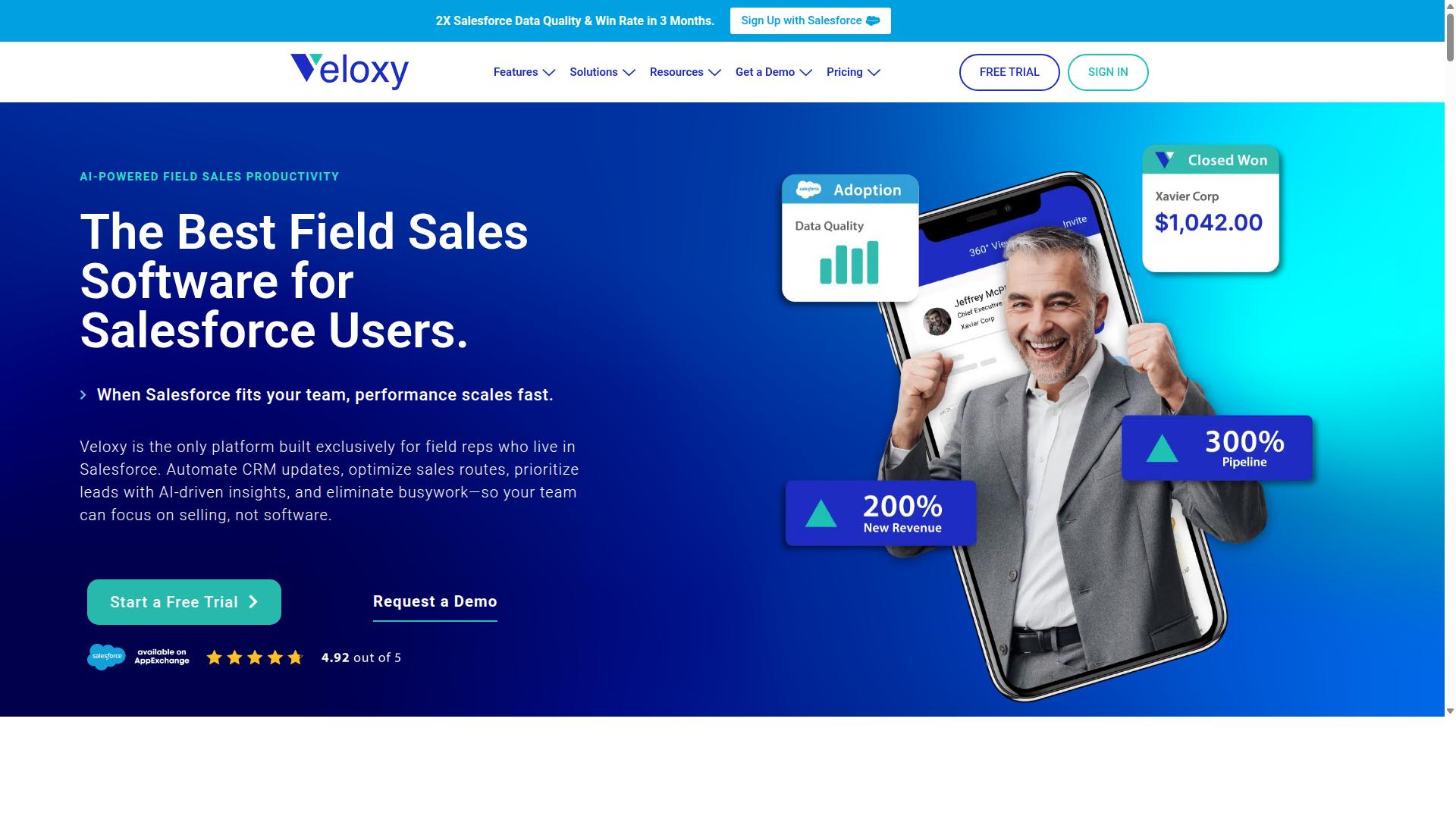
Veloxy is an AI-powered sales enablement platform built exclusively for field sales reps and managers who live in Salesforce, aiming to double sales productivity within three months. The platform is designed to streamline the daily grind of outside selling, from planning visits to logging every interaction. It exists to help reps get more out of their CRM than they put in, removing the administrative friction that eats up selling time.
At its core, Veloxy focuses on sales workflow automation and predictive insights. Instead of forcing reps to hunt for the next account or manually update records, the software feeds the right data at the right time based on context, location, and upcoming events. This approach directly supports smarter sales route planning and daily route plans, ensuring that drive time reduction and customer proximity are handled intelligently.
Key features include buying signals, lead prioritization, and a quick dialer. These tools work together to help field reps focus on the highest-value opportunities without having to search through cluttered screens. Here is how the core capabilities break down:
- Buying signals to identify accounts that are actively engaging with your outreach.
- Lead prioritization to rank prospects by readiness and potential value.
- Quick dialer to speed up call volume and reduce manual dialing errors.
- Automatic activity logging for calls, emails sent, opens, and replies, making data entry a natural step in the workflow.
Veloxy is built natively for Salesforce, which makes it a seamless addition to existing CRM workflows. Because it is not a standalone tool that requires duplicate data entry, it fits directly into the systems sales teams already use. The platform also provides sales analytics for managers, offering more accurate forecasts based on historical analysis of biases and revealing which sales activities truly drive pipeline growth.
For field sales teams comparing route optimization tools, Veloxy stands out by pairing route efficiency with deep CRM integration. It is not just about drawing a line between stops, it is about ensuring that every stop is worth the drive and that the data from that visit flows back into Salesforce automatically. This combination of route mapping, lead routing, and sales analytics makes it a strong contender for teams that want to maximize rep productivity without abandoning their CRM.
What Is SalesRabbit?
SalesRabbit is a standalone field sales management platform designed to help sales teams manage territories, track leads, and optimize routes without being tied to a specific CRM. It functions as an independent tool, which means teams can adopt it without first standardizing their customer database in a major system like Salesforce.
The platform focuses on the practical daily needs of outside sales reps. Its core strengths include territory mapping, lead tracking, and route optimization, all delivered through a clean and straightforward interface. For teams that live in spreadsheets or lightweight CRM tools, this self-contained approach can feel refreshing and easy to learn.
However, operating independently of a CRM creates a notable trade-off. SalesRabbit lacks deep integration with Salesforce, which means data often exists in silos. Reps may need to manually sync their visit notes, lead statuses, or meeting outcomes back into their primary system, adding administrative work to the end of each day.
This makes SalesRabbit a reasonable fit for organizations that do not rely on Salesforce as their system of record. Its user-friendly design reduces training time, and the mobile experience supports reps who spend most of their day on the road. For teams already deeply invested in Salesforce, though, the lack of native connectivity can become a recurring friction point.
Features Compared
This section breaks down the feature sets of Veloxy and SalesRabbit, focusing on how each handles route planning, prioritization, and real-time adjustments. The core difference comes down to automation versus manual effort.
Veloxy leverages AI and Salesforce data to streamline the entire field sales workflow. SalesRabbit, by contrast, relies on manual setup and offers a broader set of field management tools that require more hands-on configuration. Understanding these distinctions helps you decide which platform truly supports your team's daily route efficiency.
Salesforce-Native Route Planning & Execution
Veloxy's route planning is natively embedded within Salesforce, allowing reps to execute optimized routes without leaving their CRM, while SalesRabbit requires a separate platform. This deep Salesforce integration means your team works where their customer data already lives. No exports, no re-entry, no switching between tabs.
Veloxy handles the heavy lifting with automated route sequencing and address clustering. The system organizes your stops in a logical order and groups nearby accounts to minimize backtracking. This is a core part of the platform's sales route planning capabilities, built specifically for field reps who live in Salesforce.
SalesRabbit offers route planning as a standalone feature. It functions, but it requires manual data entry and lacks real-time CRM sync. Your team must keep two systems in alignment, which costs time and invites errors. When a lead changes in Salesforce, the route plan in SalesRabbit does not automatically reflect that update.
The productivity benefit of staying inside Salesforce is substantial. Veloxy users spend 90 to 95% of their time on activities that produce sales. Before Veloxy, that number was only 30 to 35%. Keeping route planning, execution, and CRM data in one place is a major reason for that jump in sales rep productivity.
AI-Driven Prioritization vs. Manual Territory Mapping
Veloxy uses AI to prioritize leads and automatically suggest the best routes, whereas SalesRabbit relies on manual territory mapping and lead assignment. This is the fundamental difference in how the two platforms approach daily route plans.
Veloxy's AI analyzes buying signals, lead scores, and historical data to determine which accounts deserve a visit and in what order. The system weighs factors like engagement and proximity to surface the highest-value opportunities first. Reps no longer guess which stop matters most; the data points the way.
SalesRabbit requires managers to assign leads and plan routes by hand. Territory mapping is a manual exercise that demands constant upkeep as reps change, accounts move, and priorities shift. This approach consumes management hours that could go toward coaching or strategy.
The time savings from AI-driven prioritization are clear. Veloxy reduces drive time by clustering nearby stops and sequencing them for maximum efficiency. When your field team spends less time on the road and more time in front of buyers, sales performance improves naturally. This is where route efficiency and lead prioritization come together in one workflow.
Real-Time Data & Buying Signals for On-the-Go Adjustments
Veloxy provides real-time buying signals and GPS-based alerts that allow reps to adjust their routes on the fly, while SalesRabbit offers limited real-time data. This live intelligence gives your team a competitive edge during the workday.
When a prospect opens an email or visits your website, Veloxy surfaces that buying signal immediately. The platform combines that insight with GPS tracking to suggest nearby high-priority leads. A rep who just finished an early meeting can see that a hot prospect is two blocks away and pivot to make the visit. This is sales call optimization in action, driven by current data rather than yesterday's plan.
SalesRabbit may offer basic GPS tracking for field rep tracking, but it lacks the AI-driven insights that make real-time adjustments valuable. Without live buying signals, reps work from static lists and miss opportunities that emerge during the day. The platform simply does not connect customer engagement data to route suggestions.
Acting on live data is what separates a good field sales day from a great one. Veloxy's ability to combine buying signals, customer proximity, and route mapping lets reps capture opportunities in the moment. This dynamic approach to customer visit scheduling keeps your team responsive and productive, even when plans change mid-morning.
Pricing Compared
Veloxy's transparent pricing starts at $65 per user per month, with discounts for annual and multi-year commitments, while SalesRabbit's pricing is not publicly disclosed. This difference in pricing transparency matters for sales teams that need to budget accurately for their field sales software.
Veloxy offers clear, predictable pricing that scales with your team. You can test the platform with a 14-day free trial before committing. For teams ready to commit, Veloxy provides meaningful savings:
- $65 per month per user on a month-to-month basis
- Save 25% with an annual subscription
- Save 50% with a 3-year commitment
- Company plans at $899 per month for 25 team members, with an annual plan that saves 45%
That works out to a full-featured field sales app for only $2 per day per rep. For most organizations, that is less than the cost of a cup of coffee, yet it directly targets sales route planning, route efficiency, and daily route plans.
SalesRabbit takes a different approach. Their pricing is not publicly available and varies by team size, so interested buyers must contact the company for a quote. This makes it harder to compare costs side by side or to plan a budget without a sales conversation first.
Veloxy also stands behind its value with a performance guarantee. If you do not get ROI in 3 months, you get 3 months free. The brand states that field sales reps typically pay off their annual Veloxy license in 1 to 2 months through improved sales rep productivity and drive time reduction.
For sales leaders comparing route optimization tools, the pricing structure alone gives Veloxy a clear advantage. You know exactly what you are paying, you can start with a free trial, and the cost per user drops significantly with longer commitments.
Who Should Choose Veloxy
Veloxy is ideal for sales teams that rely heavily on Salesforce and want to leverage AI to automate route planning and boost productivity. If your daily workflow revolves around the CRM, Veloxy fits naturally into how your reps already operate.
Field sales reps and sales managers using Salesforce will find the most immediate value. The platform is built for teams that live inside Salesforce and want their route optimization to work with their existing data, not against it.
Veloxy also suits highest-performing field sales teams that treat time as their most valuable asset. When every stop matters, AI-driven insights help reps focus on the right accounts instead of guessing which visit deserves priority.
Teams looking to reduce manual route planning will appreciate the automation. Instead of spending evenings mapping out the next day, reps can rely on intelligent sequencing that handles the heavy lifting.
Veloxy serves any sized field sales team, from small groups to large organizations. The scalability means growing teams don't need to switch platforms as they expand their territory coverage.
Key benefits for Veloxy users include:
- Increased sales rep productivity through automated daily route plans
- Better lead prioritization using AI-driven insights
- Seamless Salesforce integration that keeps CRM data current
- Reduced drive time with efficient route sequencing
Sales territory mapping and customer proximity become simpler when the software handles address clustering and route mapping automatically. Reps spend less time navigating and more time selling.
For teams targeting sales call optimization and field rep tracking, Veloxy provides the structure needed to execute consistently. The mobile sales app keeps everyone aligned on the go.
Veloxy is best for teams looking to double sales productivity within three months. That goal requires more than just better maps. It demands a system that combines sales automation, lead routing, and CRM integration into one cohesive workflow.
If your organization uses Salesforce and wants a route optimization tool that feels like a natural extension of your sales workflow, Veloxy aligns with those needs. The focus on AI-driven insights and reduced manual effort makes it a strong fit for modern field sales operations.
Who Should Choose SalesRabbit
SalesRabbit is a strong choice for teams that don't use Salesforce or prefer a standalone platform with simple territory mapping and route management. It suits organizations that want a lightweight field sales software without the complexity of a full CRM integration.
This platform tends to work well for small to mid-sized sales teams that prioritize ease of use above advanced automation. If your reps want to see their assigned leads on a map and manually plan their daily route, the straightforward interface can feel refreshing compared to heavier enterprise tools.
Teams that prefer manual control over AI automation will find SalesRabbit's approach appealing. Rather than letting algorithms decide the order of customer visits, managers and reps can arrange stops themselves, which gives a sense of ownership over the sales route planning process.
Consider SalesRabbit if your organization values flexibility over predictive routing. The platform supports basic territory management and lead tracking, making it a reasonable fit for companies that are still building out their field sales processes and want something intuitive to start with.
However, teams that rely heavily on Salesforce integration or need deep sales analytics may find the standalone nature limiting. If your sales workflow depends on syncing field activity back to a central CRM, you will need to weigh whether the simplicity of SalesRabbit outweighs the extra manual data handling.
In short, SalesRabbit is best suited for operations that want a simple, human-led approach to route mapping and territory organization. It is a practical option for those who prefer to stay in control of their daily route plan rather than handing that responsibility to automated systems.
Final Verdict
In terms of route optimization, Veloxy's AI-powered, Salesforce-native approach delivers superior efficiency and productivity gains, making it the winner for most field sales teams. The combination of intelligent lead prioritization and real-time data keeps reps focused on the right accounts at the right moments. For organizations already running on Salesforce, Veloxy removes the friction of switching between systems, so sales route planning happens inside the workflow your team already uses every day.
Veloxy wins on automation and intelligence. Its AI-driven prioritization helps reps spot high-value opportunities without manual sorting, while real-time data keeps daily route plans current as customer needs shift. That translates into better customer visit scheduling and fewer wasted miles. The seamless Salesforce integration means territory management, sales analytics, and lead routing all live in one familiar environment, which reduces training time and keeps sales rep productivity high.
SalesRabbit is not without merit. It offers solid field sales software features, including GPS tracking and route mapping, and it can serve teams that do not rely on Salesforce. If your organization uses a different CRM or no CRM at all, SalesRabbit's standalone approach may feel more accessible. Its territory mapping and customer proximity tools can still support sales visit planning for smaller or less complex field teams.
However, for teams committed to Salesforce, the choice is clear. Veloxy delivers a tighter, more automated workflow because it is built natively for that ecosystem. You avoid duplicate data entry, gain better sales analytics, and get route efficiency that adapts to changing conditions in real time. SalesRabbit's general strengths do not outweigh the integration depth and AI capabilities that Veloxy brings to the table.
If your priority is maximizing drive time reduction and sales call optimization within a Salesforce environment, Veloxy is the stronger recommendation. For non-Salesforce users with simpler needs, SalesRabbit remains a reasonable alternative. But for most field sales teams, Veloxy's combination of AI, real-time visibility, and CRM integration makes it the best fit.
We encourage you to try Veloxy's free trial and see the difference for yourself. Reach out to the team at [email protected] or [email protected], or call (510) 402-6913. Veloxy is located at 8031 Oak Creek Drive, Pleasanton, CA, 94588, and you can also connect through Facebook, Twitter, LinkedIn, and YouTube for more information.