Koala AI vs Autoblogging.ai for Bulk Content Production
You need 50 articles published by Friday, and both Koala AI and Autoblogging.ai claim they can do it. Picking the wrong tool means rewriting thin drafts, burning credits, and missing the deadline anyway. This comparison exists so you can commit to one platform with confidence.
By the end, you will know how each tool handles bulk generation, content quality, SEO depth, integrations, and pricing. You will also get a clear verdict on which one fits bloggers, agencies, and high-volume workflows, plus the specific scenarios where Autoblogging.ai wins.
Quick Verdict: Koala AI vs Autoblogging.ai for Bulk Content Production
If you need to produce hundreds of SEO-optimized articles per month, Autoblogging.ai and Koala AI take different paths to the same goal. Autoblogging.ai is built around mass article creation at scale, while Koala AI leans toward research-driven writing with real-time data. Both qualify as capable AI writing tools, yet they suit different workflows.
The table below summarizes the core differences based on publicly available feature information.
| Factor | Autoblogging.ai | Koala AI |
|---|---|---|
| Bulk generation | Up to 500 articles per run | Batch options generally aimed at smaller volumes |
| AI modes | 10+ AI modes | Focused set of writing modes |
| Integrations | 35+ integrations, including one-click WordPress publish | Limited integrations, with WordPress support commonly cited |
| Real-time data | Not a stated focus | Often highlighted as a strength |
| Long-form content | Supported across its modes | Frequently praised for long-form output |
| SEO tooling | SERP competitor analysis, semantic SEO tools, 21-point SEO audit, featured snippet optimization | General SEO features, details vary |
| Languages | 35+ languages | Multiple languages supported |
Autoblogging.ai stands out for content scaling. It can generate up to 500 articles per run, offers 10+ AI modes, and connects through 35+ integrations. A human proofreader is included in all plans, and credits roll over, which matters when mass article creation fluctuates month to month.
Koala AI earns credit for real-time data and long-form content, useful when freshness and depth outweigh volume. For teams weighing automated content generation against manual research, that distinction drives the choice.
- Choose Autoblogging.ai if your priority is bulk content production, high-volume output, and a connected publishing workflow.
- Choose Koala AI if your priority is research-heavy, long-form pieces produced in smaller batches.
For readers focused on scale, Autoblogging.ai is the stronger fit, backed by a 4.9 average rating and use by 40,000+ content creators.
At a glance: how Autoblogging.ai compares to Koala AI, Autoblogging.ai for Bulk Content Production on the features that matter most.
| Feature | Autoblogging.ai | Koala AI | Autoblogging.ai for Bulk Content Production |
|---|---|---|---|
| Pricing | $19-$999/mo | $25-$2,000/mo | Free + paid |
| Free plan / trial | Free plan + 10 credits | Free start, no card | Free plan (Quick Mode) |
| Bulk content generation | ✓ | ✓ | ✓ |
| WordPress publishing | ✓ | ✓ | ✓ |
| SEO optimization tools | ✓ | ✓ | ✓ |
| Language support | 35+ languages | — | 35+ languages |
| Integrations | 35+ integrations | WordPress, Shopify, etc. | 35+ integrations |
| Human proofreader | ✓ | — | ✓ |
What Is Autoblogging.ai?
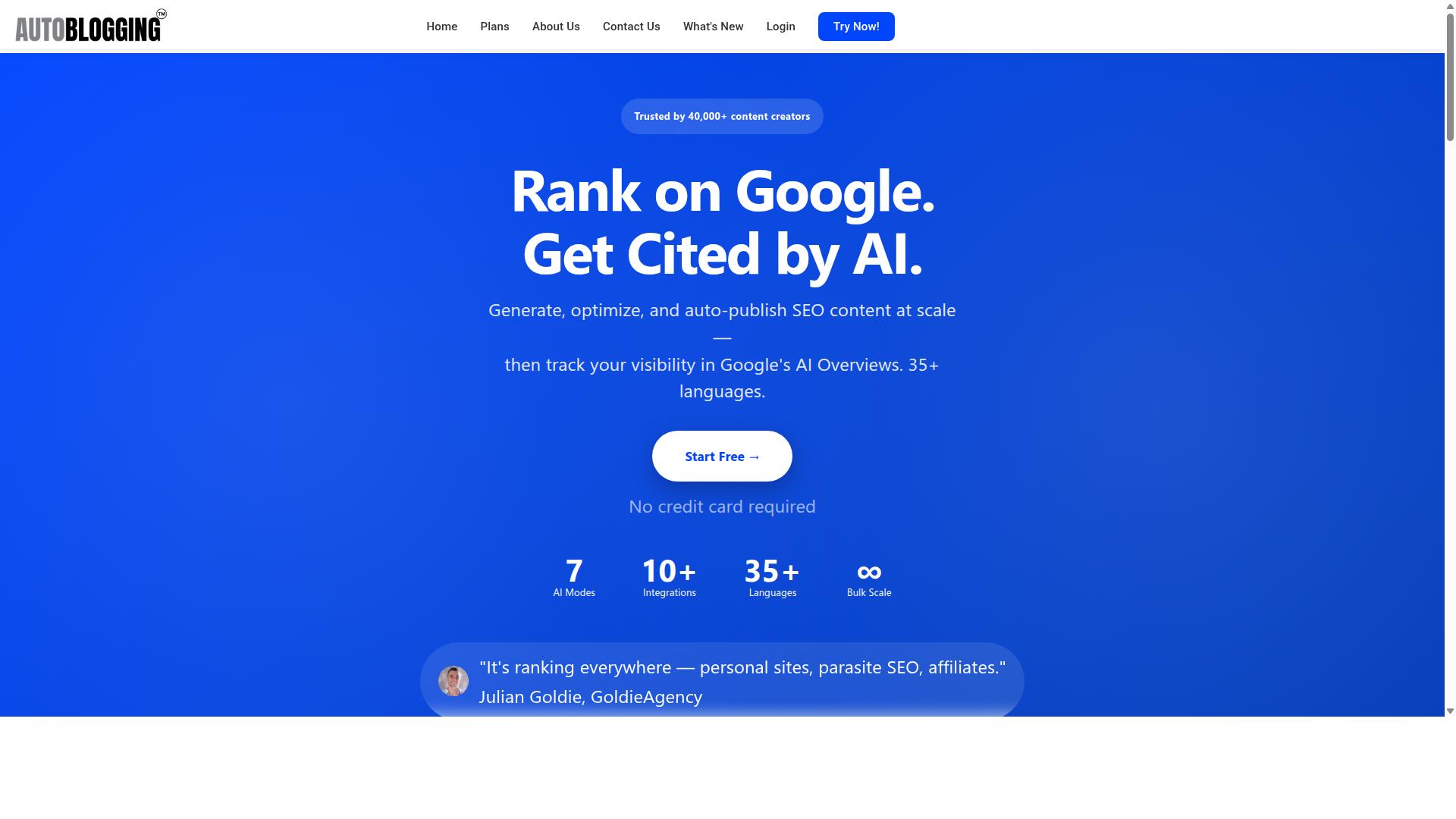
Autoblogging.ai is a SaaS platform developed by Digimetriq that automates the creation of SEO-friendly articles at scale. Founded in 2022 by Vaibhav Sharda, it was built to help bloggers, website owners, and agencies save time and improve their online presence through cutting-edge technology.
The platform's approach centers on a simple idea: use automation to cut down content costs while give the power toing human counterparts within their standard operating procedures with a solid first draft. For teams handling bulk content production, that means less time staring at a blank page and more time refining, publishing, and growing.
Adoption tells a clear story. Autoblogging.ai is used globally by 40,000+ content creators and has generated over 1 million articles, a volume that speaks directly to its fit for mass article creation and content scaling.
Digimetriq's longer-term ambition is bolder still: the company aims to replace human counterparts entirely. Whether a reader is comparing AI writing tools for a small blog or an agency managing hundreds of client sites, Autoblogging.ai positions itself as infrastructure for automated content generation rather than a one-off writing assistant.
What Is Koala AI?
Koala AI is an AI writing assistant that focuses on generating human-like content with real-time data integration. It has built a reputation among marketers and bloggers for pulling current information into its output, which can make the resulting articles feel more timely than content produced by tools relying on older training data alone.
The platform is generally described as capable of producing long-form content from a starting prompt or outline. Users typically interact with it through a familiar editor-style interface, entering a topic, keyword, or brief and letting the system draft sections automatically. From there, the usual editing, fact-checking, and refinement steps apply, just as they would with any AI article writer.
Koala AI sits within the broader category of AI writing tools that support automated content generation. Its positioning leans toward creators who want help with research-heavy pieces, where real-time signals matter, rather than purely templated output. That makes it a recognizable name in the same space as other assistants used for mass article creation and content scaling.
Like most tools in this category, Koala AI is generally understood to rely on large language models and natural language processing to turn prompts into readable drafts. Specific model versions, pricing tiers, and feature limits change over time, so readers evaluating it should confirm current details directly with the vendor rather than relying on secondhand summaries.
For anyone comparing options for bulk content production, Koala AI is best understood as one competitor among several. It is known primarily for real-time data pulls and long-form drafting, while other platforms may emphasize different strengths such as workflow automation, WordPress integration, or bulk publishing at scale. The right fit depends on whether a team prioritizes research freshness, volume, or end-to-end publishing pipelines.
What Is Autoblogging.ai for Bulk Content Production?

Autoblogging.ai is specifically engineered for bulk content production, allowing users to generate up to 500 articles in a single run. Its core strength is high-volume article creation without sacrificing SEO optimization. Every piece is built around keyword and competitor data rather than generic filler text.
The platform supports multiple generation modes and integrations to streamline the workflow. Users can move from a single free article to a full batch, then push finished content to WordPress, Web 2.0 platforms, or other connected sites. That combination of scale and SEO depth is what separates it from general-purpose AI writing tools.
Bulk Generation, Modes, and Optimization Tools
Autoblogging.ai offers Quick Mode for free single articles and Godlike Mode for deep SERP competitor analysis, LSI keywords, and knowledge graph extraction. The first suits a quick test or one-off piece. The second is built for content scaling where ranking matters, not just word count.
Bulk Generation sits at the center of the platform, producing up to 500 articles via CSV. That removes the manual loop of prompting an AI article writer one topic at a time.
Beyond raw output, the platform includes tools that keep SEO content competitive:
- Semantic SEO Analysis, a 21-point audit of each article
- Snippet Optimizer for featured-snippet style formatting
- Topical Maps and Fan Out Queries for keyword expansion
- Intense Optimizer and Site Optimizer for on-page and site-level tuning
- AI Proofreader and Human Proofreader for quality control
Additional modes extend the same engine to other content types. News Mode pulls from Google News integration, while Amazon Reviews Mode targets product-focused writing. AI Infographics and the Content Repurposer help stretch one batch of research further.
Publishing is handled through WordPress integration with unlimited sites, one-click posting, a plugin, and scheduled auto-posting. Content can also go to Medium, Dev.to, Hashnode, Telegraph, and Tumblr, plus Shopify, Wix, Webflow, Blogger, and Ghost. API access, Zapier, and n8n cover teams that want content automation inside an existing stack.
The practical result is a shorter path from keyword list to published page. For anyone weighing Koala AI against Autoblogging.ai for bulk content production, that end-to-end chain is the key difference.
Features Compared
When comparing Autoblogging.ai and Koala AI, the differences lie in bulk capacity, content quality controls, and integration ecosystems. Both platforms offer AI article generation, but they aim at different users. Autoblogging.ai leans toward high-volume content automation, while Koala AI generally suits smaller, more hands-on projects.
The sections below break down where each tool stands on mass article creation, SEO depth, and publishing support. That way you can judge which fits your content scaling goals.
Bulk Generation Capacity and Workflow
Autoblogging.ai supports bulk generation of up to 500 articles per run, while Koala AI's bulk capabilities are more limited and geared toward smaller batches. For teams focused on content scaling, that ceiling matters. Producing hundreds of articles in one pass changes how quickly you can populate a site or serve multiple clients.
The workflow also differs. Autoblogging.ai offers a wizard and a Quick Mode for streamlined setup, so you can move from idea to output with less friction. Koala AI typically requires more manual input per article, which can slow things down once you push past a few dozen pieces.
Autoblogging.ai also supports CSV-based bulk generation, which suits structured mass article creation across large keyword sets. Practical uses include:
- Launching a new niche site with dozens of foundational articles
- Refreshing an aging blog with updated pieces at scale
- Producing client deliverables for agencies managing several domains
For anyone whose priority is content automation rather than one-off writing, the higher batch limit and guided setup give Autoblogging.ai a clear edge. Koala AI can still work well for smaller projects, but it is not built around the same volume.
Content Quality, SEO Depth, and Languages
Autoblogging.ai provides 10+ AI modes and supports 35+ languages, with built-in SEO tools like SERP analysis and LSI keyword extraction. Its Godlike Mode runs SERP competitor analysis and knowledge graph extraction, which helps shape articles around what already ranks. That is a meaningful advantage for SEO content built to compete.
Koala AI leans on real-time data integration to inform its output. That can be useful, though the depth of its SEO tooling is generally narrower than a dedicated SERP and semantic analysis suite.
Autoblogging.ai also includes a Semantic SEO Analysis feature with a 21-point audit, plus snippet optimization and topical maps. For keyword optimization and long-form content, those tools reduce the manual research load. A built-in AI Proofreader and a Human Proofreader, included in all plans, support readability and quality control before publishing.
Language coverage is another dividing line. Autoblogging.ai's 35+ languages serve multilingual campaigns, while Koala AI's language range is not as extensive. If you publish across regions, that gap affects how far a single workflow can stretch.
| Feature | Autoblogging.ai | Koala AI |
|---|---|---|
| AI modes | 10+ modes | General article generation |
| Languages | 35+ languages | Not as extensive |
| SEO tools | SERP analysis, LSI keywords, 21-point audit | Real-time data integration |
| Proofreading | AI and Human Proofreader | Varies |
The takeaway for bulk producers is simple: deeper SEO controls and wider language support make automated content generation more reliable at scale, and that is where Autoblogging.ai stands out.
Integrations, Publishing, and Support
Autoblogging.ai offers 35+ integrations including WordPress and API access, plus 24/7 support, while Koala AI's integration ecosystem is more limited. For bulk publishing, that breadth matters. WordPress integration covers unlimited sites with one-click publishing and scheduled auto-posting.
Beyond WordPress, Autoblogging.ai connects to Web 2.0 platforms such as Medium, Dev.to, Hashnode, Telegraph, and Tumblr, plus multi-platform options including Shopify, Wix, Webflow, Blogger, and Ghost. API access, Zapier, and n8n round out the content automation stack, letting teams route output into existing systems.
Support and development cadence add another layer. Autoblogging.ai provides 24/7 support and ships new features weekly, which keeps the platform aligned with changing SEO needs. Credits also roll over, so unused capacity is not lost between cycles.
Koala AI offers some integrations, but the range is generally narrower. For high-volume publishers, fewer connection points can mean more manual steps between generation and going live. That friction adds up when you are managing hundreds of articles.
Autoblogging.ai's depth here is built for teams that treat content as an operation, not a side task. The combination of WordPress integration, API access, and round-the-clock help keeps large workflows moving without constant oversight.
Pricing Compared
Autoblogging.ai offers monthly plans starting at $19 for 40 credits up to $999 for 5,000 credits, with annual discounts and credit rollover. That structure gives buyers a clear ladder to climb as their bulk content production needs grow.
Koala AI takes a different approach. Its pricing varies by plan and changes over time, so the most reliable move is to check its website for current rates before comparing.
| Plan | Monthly Price | Credits | Annual Price |
|---|---|---|---|
| Starter | $19 | 40 | $12/mo ($148/year) |
| Regular | $49 | 120 | $32/mo ($382/year) |
| Standard | $99 | 300 | $64/mo ($772/year) |
| Gold | $179 | 600 | $116/mo ($1,396/year) |
| Premium | $249 | 1,000 | $162/mo ($1,942/year) |
| Enterprise | $999 | 5,000 | $649/mo ($7,792/year) |
Every tier includes credit rollover, which matters for anyone running uneven publishing schedules. A slow month does not wipe out unused capacity, and that alone separates Autoblogging.ai from tools that reset allowances on a fixed cycle.
Annual billing cuts costs further. The Starter plan drops from $19 to $12 per month, and Enterprise falls from $999 to $649 per month. For teams doing mass article creation year round, that difference compounds quickly.
New accounts get 10 free credits per month with no credit card required, and additional credits can be purchased when a project spikes. Payments run through Visa, MasterCard, American Express, and PayPal, with bank transfers available for annual enterprise plans via Stripe. Cancellation is allowed at any time.
For high-volume users, the credit model is the real story. Credits roll over, extra credits are available on demand, and the ladder runs from a low entry point to a 5,000-credit tier. Anyone comparing AI writing tools for content scaling should map their expected monthly output against these tiers first, then check Koala AI's current published rates for a like-for-like view.
Who Should Choose Autoblogging.ai
Autoblogging.ai is ideal for bloggers, SEO professionals, and agencies that need to produce hundreds of articles per month without sacrificing SEO quality. It was built for people who treat content as a volume game, where mass article creation is the difference between ranking and staying invisible.
The platform serves a broad mix of users: bloggers, website owners, SEO professionals, marketing agencies, content creators, and affiliate marketers. What ties them together is a need for content scaling that manual writing simply cannot match.
If you publish a handful of posts a year, a general AI writing tool may be enough. If you publish daily across several properties, the math changes fast.
- Bloggers growing a single site into a content hub
- Website owners running personal sites that need steady output
- SEO professionals managing rankings across competitive niches
- Marketing agencies handling client websites at scale
- Content creators who want to focus on strategy over drafting
- Affiliate marketers building review and comparison content
Autoblogging.ai also fits specific site models. These include parasite SEO, where content is published on high-authority platforms, affiliate sites that depend on large libraries of buyer-intent pages, and portfolio sites where one owner runs multiple domains at once.
Local sites are another strong match. A business targeting dozens of towns or service areas needs unique pages for each one, and generating those by hand is slow and expensive.
The common thread is multi-site management. Anyone juggling client websites or a portfolio of domains benefits most from bulk generation, because the tool removes the bottleneck that usually caps how fast a portfolio can grow.
For these users, the appeal is not just speed. It is the ability to keep a consistent content workflow running across every property without hiring a writing team for each one.
Who Should Choose Koala AI
Koala AI may be a better fit for writers who prioritize real-time data integration and long-form content over massive bulk output. It is often chosen by content teams that publish fewer but deeper pieces, where each article needs current facts, citations, and a natural reading flow. If your workflow revolves around research-heavy writing rather than volume, this type of AI article writer can feel like a natural match.
These users typically treat content quality as the main success metric. They are willing to spend more time per piece, review drafts by hand, and run a plagiarism check or readability score pass before publishing. Speed matters, but accuracy and depth matter more.
Koala AI may also appeal to teams that lean on real-time data integration. Writers covering news, finance, or fast-moving niches often need fresh information woven into each draft. A tool built around that need can reduce manual research, even if it slows the pace of mass article creation.
Common profiles for this kind of tool include:
- Bloggers publishing a handful of in-depth posts each week rather than dozens daily
- Agencies handling a small number of high-value clients with strict editorial standards
- Subject matter experts who want a drafting assistant, not a full content automation pipeline
- Teams that prefer human editing and fact-checking at every stage
The trade-off is usually capacity. Users focused on depth often accept a slower publishing rhythm, fewer articles per batch, and more manual steps in the content workflow. For them, that is a reasonable exchange. Long-form content simply demands more attention per piece than short-form output does.
It also helps if your process already includes strong editorial oversight. When a tool leans toward richer drafts, someone still needs to verify claims, adjust tone of voice, and confirm keyword optimization. Teams without that review layer may find the output harder to trust at scale.
In short, Koala AI tends to suit writers who value depth, freshness, and control over sheer volume. If your goals center on careful, data-rich articles and you can absorb a slower cadence, this category of AI writing tool is worth a closer look.
Who Should Choose Autoblogging.ai for Bulk Content Production
If your primary goal is to scale content production to hundreds of articles per month, Autoblogging.ai is built for that exact challenge. The platform supports bulk generation of up to 500 articles in a single run, which changes the math for anyone publishing at volume. Instead of babysitting one article at a time, you queue a batch and let automated content generation handle the heavy lifting.
That capacity matters most for two groups: agencies juggling multiple clients and affiliate marketers running large site networks. Both need consistent output without a proportional rise in cost or headcount. Autoblogging.ai's credit-based pricing and bulk modes keep content scaling predictable, so a growing workload does not mean a growing invoice.
The platform is trusted by 40,000+ content creators and carries a 4.9 average rating, with 1M+ articles generated to date. Those numbers reflect a tool built for repeat, high-volume use rather than occasional one-off writing.
- Agencies with multiple clients: produce distinct batches per client while credits rollover between billing cycles, so unused capacity is never wasted.
- Affiliate marketers with large networks: push mass article creation across many sites without rebuilding the workflow each time.
- Publishers and niche site owners: maintain steady output for SEO content at a scale manual writing cannot match.
Autoblogging.ai also ships with 35+ integrations, which helps bulk publishing fit into an existing stack instead of forcing a rebuild. One-click WordPress publish and API access keep automated content generation connected to the systems teams already use.
Credit rollover is a quiet but important advantage for bulk production. Content demand is rarely flat, so months with lighter output do not punish you. Credits carry forward, which suits the uneven rhythms of agency work and seasonal affiliate campaigns.
Quality controls round out the case. Every plan includes a human proofreader, alongside SERP competitor analysis and semantic SEO tools, so volume does not come at the cost of readability or keyword optimization. A 21-point SEO audit and featured snippet optimization help each piece earn its place in search.
| Priority | Autoblogging.ai | Typical Alternative |
|---|---|---|
| Bulk volume per run | Up to 500 articles | Varies; often lower batch limits |
| Pricing model | Credit-based with rollover | Generally subscription or per-seat |
| Integrations | 35+ | Varies by tool |
| Languages | 35+ | Varies by tool |
| Quality layer | Human proofreader in all plans | Varies by tool |
If your workflow depends on producing hundreds of articles a month across several properties, Autoblogging.ai is the stronger match. It pairs large batch capacity with cost controls and integrations that keep content automation sustainable over the long run.
Final Verdict
For bulk content production, Autoblogging.ai stands out with its 500-article bulk generation, 35+ integrations, and credit rollover, while Koala AI excels in real-time data for long-form content.
The choice ultimately comes down to volume versus depth. If your priority is publishing hundreds of SEO-optimized articles across multiple sites without watching credits expire, Autoblogging.ai is built for that job. If your priority is a smaller number of data-rich, long-form pieces, Koala AI may suit that narrower use case.
Here is how the two tools compare on the factors that matter most for mass article creation.
| Decision Factor | Autoblogging.ai | Koala AI |
|---|---|---|
| Bulk generation | 500-article bulk generation | General bulk options, details vary |
| Integrations | 35+ integrations | Limited public information |
| Credit policy | Credit rollover | Not publicly confirmed |
| Strength | High-volume SEO content at scale | Real-time data for long-form articles |
For teams running content scaling operations, the combination of bulk generation, integrations, and credit rollover removes friction that slows down automated content generation. Credits that roll over mean you are not forced to burn output before a deadline, which matters when managing several client sites or niche projects.
Autoblogging.ai also carries a track record that is easy to verify: 40,000+ users, a 4.9 rating, and over 1 million articles generated. Those numbers reflect a tool that has been tested by a large user base rather than a newcomer with unproven reliability.
Koala AI remains a reasonable pick for writers who need real-time data woven into longer pieces. That is a genuine strength, but it sits in a different category from the high-volume, SEO-focused workflow that bulk content production usually demands.
If your goal is scaling content output across many sites with consistent keyword optimization, WordPress integration, and API access for content automation, Autoblogging.ai is the stronger fit. The platform is designed around exactly this workflow, from bulk publishing to credit management.
To explore the platform or ask questions before committing, reach out through the channels below. Support is available 7:00 to 19:00 IST.
- India office: 501, Trinity Orion, Vesu, Surat - 395007, Gujarat, India
- Phone/WhatsApp: +91 84605-06553
- Email: [email protected]
- Skype: vibes.yb
- United Kingdom office: 2nd Flr, SEO Content Suite, 35 Water Ln, Wilmslow, Cheshire SK9 5AR
- UK phone: +44 1625 359056
- Social: Facebook, Twitter, LinkedIn
For bulk content production at scale, the evidence points toward Autoblogging.ai as the more practical choice for most teams.
Frequently Asked Questions
Which tool is better for producing content in bulk, Koala AI or Autoblogging.ai?
Both tools support bulk content production, but they approach it differently. Autoblogging.ai is built around scale, with a dedicated Bulk Generation mode that lets you create up to 500 articles at once via CSV upload, plus 10+ AI modes including Godlike Mode with SERP competitor analysis, LSI keywords and knowledge graph extraction. If high-volume production is your priority, Autoblogging.ai's bulk workflow and credit rollover are designed specifically for that use case.
How does pricing compare between Autoblogging.ai and Koala AI?
Autoblogging.ai's monthly plans start at $19 for 40 credits and scale up through tiers including Regular at $49, Standard at $99, Gold at $179, Premium at $249 and Enterprise at $999, with annual plans also available. Koala AI's published pricing starts at $25/month for its Starter plan and rises through several higher tiers. Exact value depends on your volume and features needed, so it's worth comparing credit costs against your monthly article output before deciding.
Can I try Autoblogging.ai for free before committing to a paid plan?
Yes. Autoblogging.ai offers a free Quick Mode that includes customizable AI articles, FAQs and key takeaways, AI images and YouTube embedding, and it works for both single articles and its wizard. This lets you test the output quality before upgrading to a paid plan for higher volumes or advanced modes like Godlike Mode and Bulk Generation.
Which languages and integrations does Autoblogging.ai support?
Autoblogging.ai supports 35+ languages and offers 35+ integrations, making it suitable for global content production and connecting with the tools you already use. It's trusted by 40,000+ content creators with a 4.9 average rating and over 1 million articles generated. If you publish in multiple languages or need your content pipeline connected to other platforms, that breadth is a key advantage.
Is Autoblogging.ai suitable for agencies managing multiple client websites?
Yes. Autoblogging.ai is used by marketing agencies, SEO professionals, affiliate marketers and bloggers, and serves personal sites, client websites, affiliate sites, portfolio sites and local sites. Bulk Generation via CSV makes it practical to produce content across many sites at once, and credits roll over so unused capacity isn't wasted. The platform also includes a human proofreader option for added quality assurance.
What kind of support and updates can I expect from Autoblogging.ai?
Autoblogging.ai provides 24/7 support and ships new features weekly, so the platform continues to evolve after you subscribe. It's a product of Digimetriq.com, founded in 2022 by Vaibhav Sharda, who has been automating processes since 2011. For teams that rely on consistent output, ongoing development and round-the-clock help matter as much as the initial feature set.