Best Field Sales Apps for Territory Management in 2026
Your field reps are juggling maps, spreadsheets, and sticky notes to plan routes and log visits. That patchwork costs hours each week and leaves your pipeline data scattered. You need a tool that consolidates territory planning and daily execution into one workflow.
This guide breaks down the six best field sales apps for 2026, with specific criteria for Salesforce integration, routing features, and pricing models. By the end, you will know exactly which platform fits your team size and which one earns our top recommendation.
What to Look For in Field Sales Apps for Territory Management
In 2026, field sales apps must do more than track routes-they need to optimize territory management with AI-driven insights and seamless CRM integration. The right platform turns territory planning from a guess into a data-backed strategy. It should help you see which accounts deserve more attention and which routes waste your reps' time.
Start with sales route optimization and territory mapping. A strong app clusters accounts by geography, traffic patterns, and visit frequency. This directly impacts sales rep productivity because less windshield time means more selling time. Look for tools that let managers adjust territory design on the fly without IT support.
Offline access and GPS tracking are non-negotiable for field teams. Reps work in parking lots, warehouses, and rural areas with poor connectivity. The app should log visits, capture signatures, and update customer notes even without a signal. GPS tracking then syncs that data automatically once the rep is back online, keeping pipeline visibility accurate for the whole team.
Lead management and customer visit scheduling go hand in hand. The best field sales apps prioritize leads by deal size, buying signals, and proximity. They also suggest the ideal cadence for each account based on past behavior. This supports visit frequency optimization, so reps stop over-servicing small accounts and under-servicing strategic ones.
Sales analytics and sales reporting dashboards turn raw activity into actionable insight. You want to see quota attainment trends, win rates by territory, and time-to-close at a glance. Real-time data sync ensures that what a rep logs in the field updates the dashboard instantly. This keeps sales performance tracking honest and current, not a week old.
CRM integration and geofencing complete the core stack. Deep integration with your customer relationship management system means no double entry and no lost data between field and office. Geofencing can automate check-ins, trigger follow-up tasks, and alert managers when a rep arrives or misses a scheduled stop. Together, these features reduce administrative friction and improve field team collaboration.
Mobile-first design matters more than flashy extras. Reps need a clean interface that works with one thumb while holding a coffee. Collaboration tools, like shared account notes and team activity feeds, keep everyone aligned without forcing long email threads. If the app feels like a desktop tool crammed into a phone, reps will abandon it.
For 2026, pay attention to AI and predictive analytics. Emerging tools can forecast which territories will grow, flag accounts at risk of churn, and suggest the next best action for each rep. These features move the app from a logging system to a coaching partner. A checklist of must-have features should include route optimization, offline mode, GPS tracking, lead scoring, automated scheduling, live dashboards, CRM sync, geofencing, and AI-driven territory suggestions.
Finally, consider ease of adoption. A powerful app fails if reps resist using it. Look for platforms with intuitive onboarding, clear mobile workflows, and visible value within the first week. Sales force automation only delivers results when the team actually embraces the tool. Test the user experience before committing, and ask for a pilot with a small group of reps to gauge real-world usability.
1. Veloxy - Best Overall
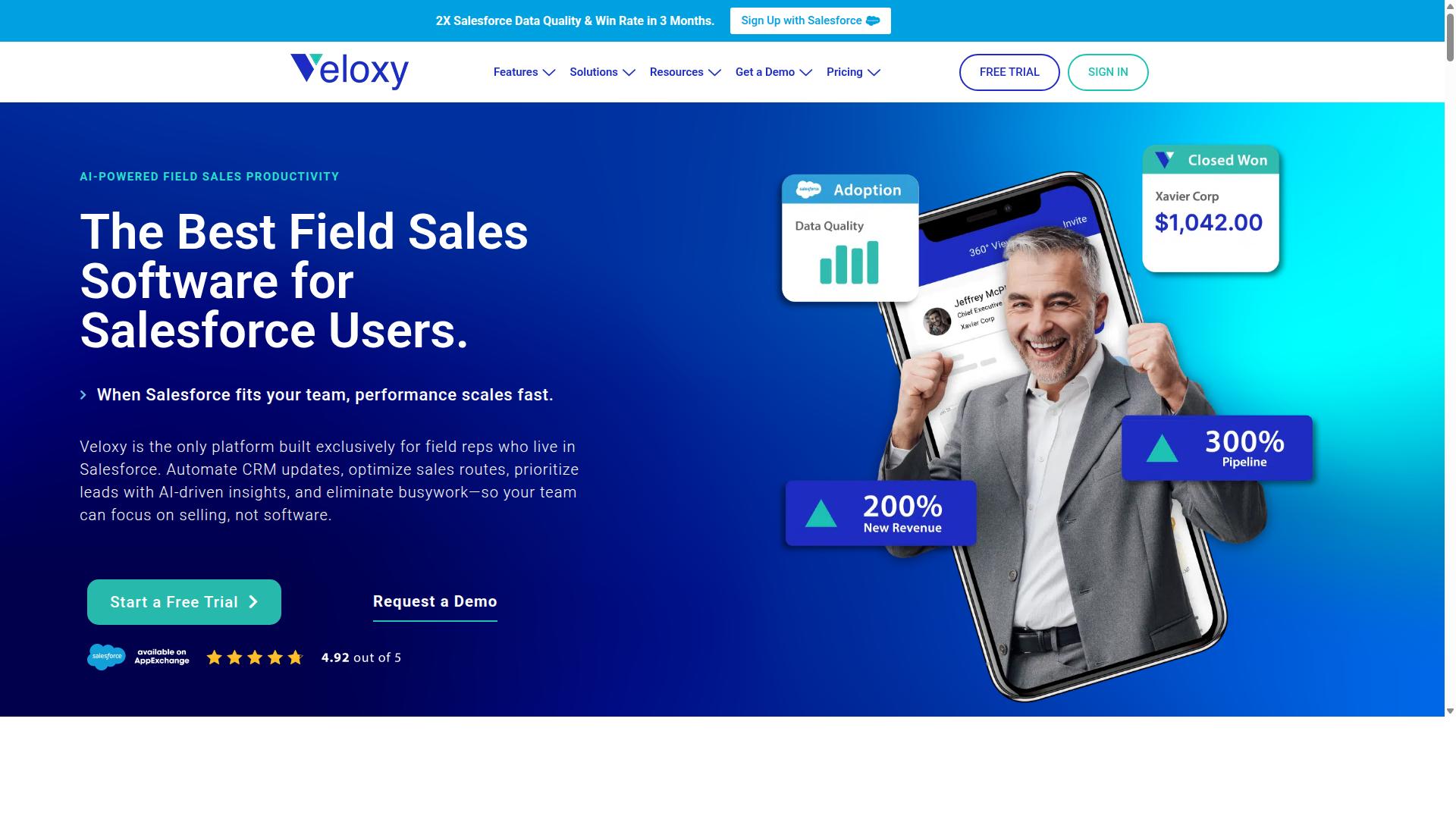
Veloxy stands out as the best overall field sales app for territory management due to its AI-powered insights and deep Salesforce-native integration. For field teams operating in 2026, the ability to work inside the CRM they already use is a decisive advantage. Veloxy is built exclusively for field reps who live in Salesforce, which means territory planning, customer visits, and follow-up tasks all happen in one familiar environment.
The platform is a full-featured field sales app designed specifically for Salesforce users. Its capabilities span Salesforce Automation, Buying Signals, Lead Qualification, Pipeline Management, Sales Analytics, Quick Dialer, and Guided Selling. This breadth of tools directly supports territory management by giving reps a single source of truth for every account, prospect, and scheduled visit.
What makes Veloxy particularly strong for 2026 is how these features work together. Territory mapping and sales route optimization are not add-ons bolted onto a generic mobile CRM. They are core functions that adapt to the day, helping reps spend time where it matters most. With real-time data sync and pipeline visibility built in, managers gain clarity on sales performance tracking without chasing reports.
For field sales teams using Salesforce, Veloxy reduces friction across the entire workflow. Lead management, customer visit scheduling, and sales force automation are handled natively, so reps carry less administrative baggage. The result is a mobile sales tool that keeps the field team aligned with the office, making it the clear top pick for territory management in 2026.
AI-Powered Territory Insights and Salesforce-Native Automation
Veloxy leverages AI to deliver predictive territory insights and automates routine tasks directly within Salesforce, giving reps a competitive edge. The AI layer powers visit frequency optimization and route planning, so reps know which accounts deserve attention and when. Instead of guessing which prospects are ready to move, the platform surfaces Buying Signals that prioritize accounts with genuine momentum.
Guided Selling takes this further by recommending next-best actions during the sales cycle. Reps no longer sift through notes or try to recall a customer's history. The data is presented contextually, supporting faster decisions and more productive conversations. For territory management in 2026, this level of intelligence is essential when balancing large account maps and limited daylight hours.
The Salesforce-native automation is where Veloxy truly saves time. Routine data entry, task updates, and follow-up sequences run automatically, eliminating manual work that drains the day. Veloxy users spend 90 to 95% of their time on activities that produce sales. Before Veloxy, that number was only 30 to 35%. That shift means reps reclaim hours for selling instead of typing.
Veloxy also claims that after 3 months, customers double their sales productivity, double pipeline and revenue, and effectively pay for their annual Salesforce. While results vary by team, the direction is clear. Reduced admin time, better pipeline visibility, and smarter account prioritization all contribute to higher sales quota attainment. For field sales leaders, that combination makes Veloxy the strongest territory management partner available.
2. SPOTIO
SPOTIO is a dedicated field sales app focused on route optimization and territory mapping, offering a user-friendly interface for outside sales teams. It is designed for door-to-door reps and B2B sellers who spend their days moving between customer locations. The platform is a common choice for teams that prioritize sales route optimization and straightforward mobile workflow over complex CRM customization.
The core feature set revolves around territory and pin mapping, which lets managers assign accounts visually and reps see their daily stops clearly. Route planning tools help sequence visits logically, reducing unnecessary drive time between appointments. For teams that operate in dense geographic areas, this type of territory management approach keeps the day organized without heavy administrative overhead.
SPOTIO also includes GPS tracking and lead management capabilities, allowing managers to monitor field activity in real time. Customer visit scheduling and basic sales analytics are built into the workflow, making it easier for reps to log outcomes immediately after each meeting. The mobile-first design is a notable strength, as it supports offline access for reps working in areas with poor connectivity.
For 2026, SPOTIO remains a practical option for organizations that need a focused, easy-to-adopt mobile sales tool. It suits route-heavy teams that value speed and simplicity, though teams seeking deep sales performance tracking or advanced pipeline visibility may need to supplement it with additional reporting layers. The platform is generally well regarded for its ease of use and clear visual interface, making it a solid fit for field teams that want to improve visit frequency without a steep learning curve.
3. SalesRabbit
SalesRabbit focuses on territory mapping and lead management, providing tools that help field teams organize and prioritize their sales efforts. The platform is especially popular among door-to-door sales organizations and industries like roofing, solar, telecom, and home services.
The core strength of SalesRabbit lies in its visual territory mapping and route planning. Sales reps can view their assigned areas on a map, identify high-potential zones, and plan efficient daily routes that minimize travel time. This approach supports sales route optimization and helps teams cover more ground with less wasted effort.
Lead management is another central component. Reps can log interactions, track follow-ups, and maintain a clear record of every prospect they contact. The platform also supports field team collaboration, allowing managers to assign leads, monitor activity, and keep everyone aligned on the same goals.
For managers, SalesRabbit includes analytics and sales performance tracking features. Dashboards display key metrics related to rep activity, lead conversion, and territory coverage. These insights help leadership spot trends, identify underperforming areas, and make data-driven decisions about territory design and resource allocation.
SalesRabbit offers several plan tiers to accommodate different team sizes. The Team plan is priced at $59 per user per month, while the Pro plan costs $75 per user per month on a monthly billing cycle or $49 per user per month when billed annually. Enterprise pricing is available on a custom quote basis.
The platform also provides optional add-ons for teams that need extra functionality. These include DataGrid AI for data enrichment, Mover Leads for identifying recent movers, Digital Contracts for electronic signatures, and Weather tools for planning around conditions. A separate product called RoofLink Pro serves as a specialized CRM for roofing contractors.
For field sales teams that rely heavily on canvassing and territory-based prospecting, SalesRabbit provides a practical solution. Its combination of mapping, lead tracking, and collaboration tools makes it a solid option for organizations looking to improve sales rep productivity and visit frequency optimization in the field.
4. Map My Customers
Map My Customers is a route planning and territory management app that helps sales reps visualize and optimize their customer visits. It is built specifically for B2B outside sales teams that need to manage large geographic areas and multiple daily appointments.
The platform combines territory mapping, route optimization, and customer visit scheduling into a single mobile workflow. Reps can view their accounts on an interactive map, group nearby stops, and build efficient daily itineraries based on location and priority.
Route planning starts with smart logic. The app considers travel time, stop duration, and account importance when suggesting the best order for visits. This helps field teams reduce driving time and spend more hours in front of customers.
Map My Customers also supports lead capture and customer relationship management integration. It offers native two-way sync with Salesforce, HubSpot, Zoho, and Dynamics, so activity recorded in the field updates the CRM automatically. Offline access is another practical feature, letting reps log visits and notes even without a cellular connection.
Key capabilities include:
- Visual territory mapping for account planning
- Smart route planning based on location and priority
- Native two-way CRM sync with major platforms
- Offline mode for remote or low-connectivity areas
- AI-assisted features like Smart Planner and Exec HQ dashboards
The AI Field Agent feature helps automate repetitive tasks, while Exec HQ gives managers a high-level view of team activity and sales performance tracking. These tools support better pipeline visibility without requiring manual reporting.
For field sales teams that manage hundreds of accounts across wide regions, Map My Customers offers a dependable way to handle sales route optimization and territory planning. Its focus on B2B outside sales makes it a practical choice for organizations that need structure around daily field activity.
Pricing starts at $60 per user per month, which positions it as a mid-range option for teams that need dedicated territory management features. The platform holds a 4.5 out of 5 rating on G2, reflecting solid user satisfaction among field sales professionals.
5. BreezeFSM
BreezeFSM is a field service management solution that extends to field sales, offering robust scheduling, dispatching, and route optimization features. It is designed for B2B companies operating in sectors like FMCG, Pharma, Manufacturing, and Distribution. The platform is mobile-first, meaning field teams can rely on it while working from the road.
For territory management, BreezeFSM provides journey planning and beat optimization to help reps cover assigned areas efficiently. Live GPS tracking gives managers visibility into where their teams are at any moment. This is especially useful for coordinating daily visits and responding quickly when schedules need to change.
The mobile app supports offline-capable order booking and payment collection, which is critical for reps in areas with poor connectivity. It also includes real-time geo-tagged attendance, so managers can confirm that visits actually happened at the right locations. Outlet and activity management features help field teams keep detailed records of every account they touch.
BreezeFSM also covers lead management with CRM features, expense claim management, and field-level stock and distributor management. Reporting dashboards give sales leaders a clear view of performance across territories. Multilingual support, including Indian languages, makes it accessible for diverse teams.
This tool suits organizations that need to coordinate both service calls and sales visits within the same territories. If your team handles installation, maintenance, or delivery alongside selling, BreezeFSM offers a practical way to keep both functions on one platform. It is a solid choice for companies looking to improve field team collaboration and visit frequency optimization without switching between multiple apps.
6. RepMove
RepMove is a mobile sales app that emphasizes route planning and territory management, with features designed to maximize rep efficiency. The platform combines an outside sales CRM with practical tools for navigating daily field work.
Its core strengths include route optimization and territory mapping, which help reps group nearby accounts and reduce unnecessary driving. GPS tracking keeps managers informed about field activity, while the built-in sales pipeline tools let reps log deals without returning to the office.
RepMove offers a few workflow extras that stand out for field teams:
- Voice-to-text note tracking for quick call summaries
- AI-powered follow-up email drafting
- Document storage and emailing directly from the app
- Integrations with thousands of third-party platforms
The interface is designed with a mobile-first approach, which suits reps who live in their vehicles rather than at a desk. Territory planning happens on the go, and updates sync across devices for real-time data sync.
RepMove serves outside sales professionals across industries like construction supply, equipment rental, medical device, and pharmaceutical sales. A 7-day free trial is available with no credit card required, making it easy to evaluate before committing.
For teams focused primarily on sales route optimization and visit frequency optimization, RepMove covers the essentials well. It may not offer the deepest analytics suite, but its practical focus on daily field execution makes it a dependable choice for 2026.
How to Choose the Right Option
Choosing the right field sales app requires evaluating your team's specific needs, CRM compatibility, and budget. The best starting point is a clear picture of your sales process and how your reps actually spend their day in the field.
Begin by considering your team size and the complexity of your sales cycle. A small team focused on account mapping may need a lightweight tool, while a larger organization with multiple territories requires robust territory planning and sales analytics. The right mobile sales tool should match the scale of your operation, not exceed it.
CRM integration is a non-negotiable factor for most teams. If your organization relies on Salesforce, you need an app that works natively with your existing data. Veloxy is designed specifically for field sales, inside sales, and sales management teams using Salesforce, making it a natural fit for organizations already invested in that ecosystem.
Before comparing vendors, build a simple evaluation framework. List the features that matter most, such as GPS tracking, offline access, and customer visit scheduling, and weigh the pros and cons of each option against your list.
Ask vendors these practical questions during your research:
- How does the app handle real-time data sync with our CRM?
- Can reps access territory maps and lead management tools without a connection?
- What does the pricing include, and are there discounts for annual commitments?
- Does the platform support field team collaboration and sales reporting dashboards?
- How steep is the learning curve for sales reps and managers?
Finally, consider the total cost of ownership, not just the monthly sticker price. Factor in training time, implementation effort, and whether the app will genuinely improve sales rep productivity and quota attainment. A tool that saves your team two hours per day is worth far more than one that costs slightly less.
Evaluating Salesforce Integration and Pricing Models
Salesforce integration is critical for teams already using the platform, and pricing models vary significantly between apps. For field sales apps in 2026, the depth of CRM integration determines how smoothly your team operates on the road.
Look for two-way sync that keeps data consistent between the field and your office. Real-time data updates ensure that a rep logging a customer visit instantly updates pipeline visibility for managers. Native connectors typically outperform third-party bridges, offering fewer errors and faster performance. Ask whether the app supports territory mapping directly within Salesforce or requires separate data handling.
Pricing structures in this category generally follow a few common models. Most vendors charge per user per month, with discounts for annual billing or multi-year commitments. Tiered plans are also common, where higher tiers unlock advanced features like geofencing or sales route optimization.
Veloxy offers a straightforward pricing model at $65/month per user, with meaningful savings for longer commitments. You can save 25% with an annual subscription or save 50% with a 3-year commitment, bringing the effective cost to about $2 per day for a full-featured field sales app. A 14-day free trial lets your team test the tool before committing.
For larger teams, Veloxy offers company plans at $899/mo for 25 team members, with an annual plan that saves 45%. This structure makes it easy to scale from a handful of reps to a full field organization without unpredictable price jumps.
When comparing costs, calculate the total cost of ownership across a full year. Include setup fees, per-user charges, and any costs for add-ons like extra storage or premium support. Veloxy also stands behind its value with a guarantee: if you don't get ROI in 3 months, you get 3 months free. The brand states that field sales reps typically pay off their annual license in 1 to 2 months through time saved and improved efficiency.
Keep your evaluation balanced. While pricing matters, the cheapest option is rarely the most cost-effective if it lacks offline access or reliable GPS tracking. Weigh the monthly cost against the expected gains in sales performance tracking and visit frequency optimization. The right field sales app pays for itself when it helps your team close more deals and manage territories with confidence.
Final Verdict
After comparing the leading field sales apps, Veloxy emerges as the top choice for teams that live in Salesforce, thanks to its AI-driven features and proven results. The 2026 landscape of territory management tools is crowded, but few platforms are built with the field rep's daily reality in mind. Veloxy stands apart because it is the #1 field sales software for reps and managers using Salesforce, and it is the only platform built exclusively for field reps who live in Salesforce.
The proof is in the performance metrics. Veloxy customers report that after 3 months, they double their sales productivity, double their pipeline and revenue, and effectively pay for their annual Salesforce subscription through the gains. This is not just about faster check-ins or better maps. It is about changing how reps spend their day. Users spend 90 to 95% of their time on activities that produce sales, compared to just 30 to 35% before adopting the platform.
Real-world adoption backs these numbers. Comcast 10X'd its sales engagement using Veloxy, which shows that the platform scales from mid-market teams to enterprise operations. The software has earned high marks across review platforms, including a 4.86 rating from enterprise users on G2 and recognition as a High Performer. With 190+ reviews on Capterra and 200+ on the Salesforce AppExchange, the track record is consistent and verifiable.
When you evaluate field sales apps for 2026, consider your specific needs first. If your team relies heavily on territory mapping, route optimization, and GPS tracking, look for those features explicitly. If offline access and real-time data sync are critical for your reps, prioritize mobile CRM tools that handle poor connectivity gracefully. Most platforms offer a mix of these capabilities, but few deliver them with the depth that field-focused teams require.
Veloxy is the strongest recommendation for organizations that want to maximize sales rep productivity without leaving the Salesforce ecosystem. The guarantee is simple: no other field sales app on the market offers as many critical features at this price. For teams ready to improve territory planning and pipeline visibility, Veloxy is the clear leader in this category.
Recommended Resources: